Top Landscaping Services in Richmond, VT, 05466 | Compare & Call

Morning Dew Landscaping & Stonework
Morning Dew Landscaping & Stonework, founded in 2004 by Vermont Certified Horticulturist Matt Leonetti, brings a deep-rooted expertise to Richmond's outdoor spaces. Matt's career began in Ohio with la...
J&K Landscapes is a family-owned business serving Richmond, VT, since spring 2022. We specialize in lawn services, junk removal, and snow removal, providing reliable solutions for local homeowners. Ou...

Lily of the Valley Landscape & Design is a dedicated local landscaping company serving Richmond, Vermont. We specialize in expert gardening and comprehensive landscape maintenance to help homeowners a...
D&B Mowing, a locally-owned lawn care service in Richmond, VT, is built on a foundation of dedication and community values. Founded by two Eagle Scouts, the company operates with a commitment to relia...
Bessette's Lawn Care is a trusted local landscaping company serving Richmond, VT, dedicated to maintaining beautiful, healthy outdoor spaces for homeowners and businesses. We specialize in addressing ...
Landshapes is a full-service landscape design-build firm that has been a trusted name in Richmond, Vermont, and throughout New England since 1992. Our team specializes in turning outdoor spaces into p...

Vermont Land Maintenance
Vermont Land Maintenance is a Richmond-based company specializing in landscaping, wildlife hunting ranges, and excavation services. We help local homeowners tackle common landscaping challenges like l...
Questions and Answers
How can I keep my lawn healthy during dry spells without wasting water or violating any town rules?
While Richmond has no mandatory water restrictions, voluntary conservation is critical. Drip irrigation with soil moisture sensor integration is the technical standard for efficiency. This system applies water directly to the root zone of your Kentucky Bluegrass and Fine Fescue mix, only when the soil's evapotranspiration (ET) demand requires it. This method can reduce potable water use by up to 50% compared to traditional sprinklers, maintaining turf health within municipal guidelines.
I've spotted what looks like Japanese Knotweed and Garlic Mustard. How do I deal with these without harming my soil?
Those are high-priority invasive species alerts. Manual removal and careful, targeted herbicide application are required, timed outside of peak growing seasons to protect native flora. Crucially, any response must comply with Vermont's Phosphorus Fertilizer Law, which prohibits phosphorus applications on established turf. Soil health is preserved by following treatment with replanting using aggressive native competitors like Joe Pye Weed to fill the niche.
I want to reduce mowing, gas usage, and noise. What are my options for replacing some lawn?
Transitioning to a xeriscape or meadow garden with Vermont natives like Serviceberry, Wild Bergamot, and New England Aster is a forward-thinking strategy. These plants require no fertilization, minimal watering once established, and eliminate weekly mowing. This approach pre-emptively addresses evolving noise ordinances concerning gas-powered equipment and creates a higher-biodiversity landscape that supports local pollinators and bird species.
Is a Vermont slate patio a better long-term investment than a wood deck for my property?
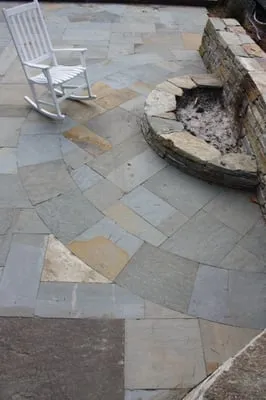
For longevity and reduced maintenance, mineral hardscapes like slate or crushed stone are superior. Wood requires cyclical sealing and deteriorates, while stone is permanent and inert. In Richmond's Moderate Wildland-Urban Interface rating, non-combustible stone also contributes directly to defensible space, a key Firewise principle. A properly installed dry-laid stone patio also offers excellent permeability, complementing drainage solutions.
My yard stays soggy well into spring and I'm worried about frost heave damaging my walkways. What's the solution?
This is a classic symptom of our high seasonal water table interacting with dense, fine sandy loam. The primary fix is installing subsurface French drains to intercept and redirect groundwater. For any new patios or paths, specify permeable bases and Vermont slate or crushed native stone set with open joints. This design increases surface permeability, reduces runoff volume, and meets Richmond Planning & Zoning Department's stormwater management standards.
My lawn looks thin and struggles every summer. Could the age of my Richmond Village home be a factor?
Properties in the neighborhood, often dating to the 1930s, have soil profiles nearly 90 years in the making. The prevalent acidic fine sandy loam becomes heavily compacted over decades, restricting root growth and water infiltration. Core aeration is not merely beneficial but essential to break up this pan and incorporate organic compost. This process directly addresses the low permeability and naturally low pH, which can limit nutrient availability for standard turf grasses.
What do I need to know about permits and hiring someone to regrade my half-acre lot?
Any significant regrading that alters stormwater flow or involves cut/fill exceeding town thresholds requires a permit from the Richmond Planning & Zoning Department. For a 0.50-acre lot, this is likely. You must hire a contractor licensed by the Vermont Office of Professional Regulation for landscaping. This ensures they carry proper insurance and adhere to state laws regarding erosion control and the legal property line boundaries, protecting you from liability.
A storm brought down a large limb. How quickly can a crew arrive for emergency cleanup in Richmond?
For urgent HOA compliance or safety issues, our dispatch from the Old Round Church area allows for a 20-30 minute peak response time. The route utilizes I-89 for rapid access throughout Richmond Village. Initial safety and debris clearing can commence immediately upon arrival, with full site remediation following a brief assessment to prioritize hazards and property protection.
