Top Landscaping Services in Trappe, MD, 21673 | Compare & Call

BJ and Son Property Management
BJ and Son Property Management is a family-owned, licensed, and insured business serving the Eastern Shore of Maryland from their home base in Trappe. With over four decades of combined experience, th...
Common Questions
My lawn in the Main Street Historic District feels compacted and thin. Is this a common problem for older Trappe properties?
Yes, this is a direct consequence of soil age and type. Homes built around 1978, common in your area, have soils that have matured for nearly 50 years. Sassafras Sandy Loam naturally compacts under decades of foot traffic and standard mowing. The soil structure degrades, reducing permeability for air, water, and roots. Annual core aeration and top-dressing with composted organic matter are essential to rebuild soil tilth and support healthy turf.
We need some regrading done. What should I verify about a contractor's credentials before signing a contract?
For any grading or earthwork on a 0.35-acre lot, you must verify two key credentials. First, the contractor must hold a valid license from the Maryland Home Improvement Commission (MHIC), which provides legal recourse and guarantees a minimum level of professionalism. Second, the scope of work likely requires a permit from the Talbot County Office of Planning and Zoning, as grading alters stormwater flow patterns. A legitimate contractor will handle this permitting process, ensuring the work meets all county erosion and sediment control standards.
I've spotted what looks like Japanese stiltgrass. How should I handle invasive weeds without harming my lawn?
Japanese stiltgrass is a prevalent invasive alert for Maryland. Correct identification is the first step, as treatment timing is critical. For established lawns, a targeted post-emergent herbicide applied in late summer before seeding is most effective. Crucially, any treatment plan must operate within the blackout dates and phosphorus restrictions of the Maryland Lawn Fertilizer Law. A soil test is mandatory to inform any nutrient application, ensuring you address the weed without violating local ordinances.
My backyard stays soggy for days after rain. What's causing this, and what's a long-term fix?
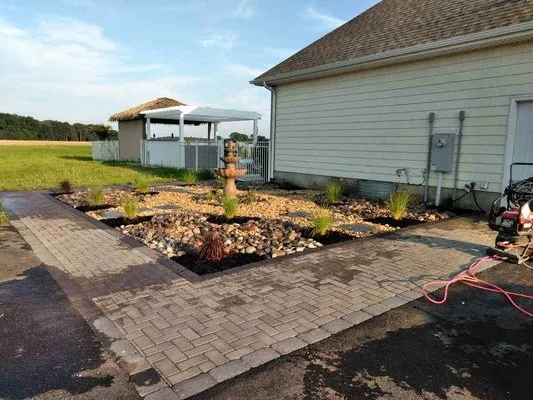
This is a classic symptom of our local conditions: a high water table combined with the poor infiltration rate of compacted Sassafras Sandy Loam in low-lying areas. Water simply cannot percolate down quickly enough. A sustainable fix involves improving permeability. Replacing impervious surfaces with permeable concrete pavers for patios or walkways allows stormwater to infiltrate on-site, which aligns with Talbot County runoff management standards and directly alleviates the ponding in your yard.
With voluntary water conservation in effect, how can I keep my Tall Fescue lawn healthy through the summer?
Efficient irrigation is key under Stage 0 conservation. A smart, Wi-Fi ET-based system is the technical solution. It automatically adjusts watering schedules by using local weather station data to calculate real-time evapotranspiration (ET), applying only the precise amount of water lost. This method prevents overwatering, encourages deeper root growth in Tall Fescue, and keeps your usage well within municipal guidelines, effectively preserving the turf while conserving a shared resource.
We're adding a patio. Are permeable pavers a better choice than traditional wood or concrete?
For longevity and ecological function in Trappe, permeable concrete pavers are superior. Unlike wood, they do not rot, warp, or attract pests, providing a permanent structure. Compared to solid concrete, their key advantage is managing stormwater on-site, a critical need given local drainage hazards. Furthermore, their non-combustible nature contributes to defensible space, which is a prudent consideration even in our current Low Fire Wise rating zone for the suburban-rural interface.
A storm knocked down a large limb. How quickly can a crew respond for an emergency cleanup in my neighborhood?
For urgent situations like storm debris blocking access, our dispatch prioritizes a rapid response. A crew would mobilize from our central location near the Trappe Town Hall, taking US Route 50 to your address in the historic district. Accounting for local traffic, we can typically have a team on-site for initial assessment and safety mitigation within the 20-30 minute window during peak conditions, ensuring compliance with all local roadway safety protocols.
I want to reduce mowing and gas-powered maintenance. What are some resilient, lower-maintenance plant options?
Transitioning to a landscape anchored by Maryland natives is the most effective strategy. Plants like Eastern Redbud, Switchgrass, Black-eyed Susan, and Swamp Milkweed are adapted to our Zone 7b climate and soils, requiring minimal supplemental water once established. This xeriscaping approach drastically reduces mowing, eliminates the need for gas-powered blowers—keeping you ahead of tightening noise ordinances—and provides critical habitat, supporting 2026 biodiversity goals for the suburban-rural interface.
