Top Landscaping Services in Gentry, AR, 72734 | Compare & Call

Jiffy Brothers Landscaping is a locally owned and operated business serving Gentry, AR, founded by two brothers dedicated to providing reliable landscaping and house sitting services. With over three ...
Brothers Property Solutions is a trusted lawn care provider serving Gentry, AR, and the surrounding Northwest Arkansas area. We specialize in comprehensive lawn maintenance, including regular mowing, ...
Serving Gentry, AR, Burns Lawn Care is your local expert for dependable lawn services. We understand the unique challenges homeowners face in our area, from clogged irrigation heads that prevent prope...
NWA Lawn & Gutter is a mobile lawn and gutter service based in Gentry, AR, dedicated to enhancing local outdoor spaces. As a mobile business, we bring our services directly to your property, offering ...

SkidMarks is a Gentry-based excavation and landscaping company dedicated to solving common local yard challenges. Many homeowners struggle with patchy, unhealthy lawn grass and poor drainage that lead...
Questions and Answers
We want to regrade our backyard for better drainage. Do we need a permit, and what should we verify about a contractor?
Yes, significant regrading on a 0.25-acre lot typically requires a permit from the Gentry Planning & Zoning Department to ensure compliance with erosion control and stormwater management ordinances. More critically, you must hire a contractor licensed by the Arkansas Contractors Licensing Board for earthwork. This licensing guarantees they carry proper insurance, understand local soil conditions like our compacted clay, and will execute the work to code, protecting you from liability and substandard results.
We've spotted what looks like invasive Johnsongrass. How should we handle it without harming our garden or breaking local rules?
Johnsongrass is a serious invasive alert for our area. Manual removal of young plants, ensuring the entire rhizome is extracted, is effective for small patches. For established infestations, a targeted, systemic herbicide applied in late summer when the plant is translocating nutrients to roots is most effective. This must be done on unfrozen ground and in calm weather to avoid drift, strictly adhering to Arkansas BMP guidelines. Never apply near desirable plants or before a forecasted rain.
We're adding a patio and are deciding between wood and stone. Which offers better longevity and safety for our wooded lot?
Native Ozark sandstone is superior for longevity and fire safety. Unlike wood, it is non-combustible, requires no sealing, and withstands freeze-thaw cycles for decades. In Gentry's Moderate (WUI Zone 2) fire risk area, using stone for patios, walkways, and retaining walls creates critical defensible space by interrupting fuel continuity. This hardscape choice adds permanent value, reduces maintenance, and enhances property resilience compared to combustible wood alternatives.
Our Gentry lawn seems thin and struggles in summer, but our neighbor's is lush. Could the age of our homes affect the soil?
Yes, soil maturity is a primary factor. Homes built around 1995, common in Downtown Gentry, have soils approximately 31 years old. During construction, the native acidic silt loam topsoil was often stripped or compacted under clay subsoil, leading to poor structure and low organic matter. This compaction restricts root growth and water percolation, explaining summer stress. Corrective core aeration and amendments like composted pine bark are required to rebuild soil biology and structure.
Water pools in our backyard after heavy rain. What's causing this, and what's a lasting fix that might also look good?
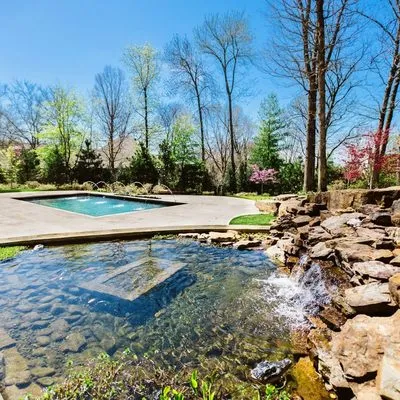
Pooling is typical in Gentry's acidic silt loam over compacted clay subsoil, which creates moderate runoff hazards. The clay layer has very low permeability, preventing infiltration. A lasting solution involves installing a French drain system tied to a dry creek bed or swale. Using permeable native Ozark sandstone for bordering these features adds aesthetic value while meeting Gentry Planning & Zoning Department runoff standards by increasing surface infiltration and controlling erosion.
With Gentry in Stage 1 water restrictions, how can we keep a Tall Fescue lawn healthy without wasting water?
Smart, Wi-Fi ET-based irrigation controllers are the standard solution. These systems use local weather data to calculate evapotranspiration (ET) and apply only the precise water needed, often reducing usage by 20-30%. For Tall Fescue in Zone 7a, this means deep, infrequent watering cycles that encourage drought-tolerant roots. Programming aligns with municipal restrictions, preventing runoff and ensuring every gallon supports turf health during our hottest months.
We're tired of weekly mowing and gas equipment noise. Are there lower-maintenance, eco-friendly alternatives to our lawn?
Transitioning sections of high-maintenance turf to a xeriscape of native plants is a forward-looking strategy. Species like Purple Coneflower, Little Bluestem, and Butterfly Milkweed are adapted to Zone 7a, require minimal water once established, and support local pollinators. This reduces mowing frequency, fuel costs, and noise—a proactive step as municipalities increasingly regulate gas-powered blowers. The resulting landscape is resilient, biodiverse, and aligns with 2026 ecological landscaping standards.
A storm damaged trees on our property. How quickly can a crew respond for emergency cleanup to meet HOA deadlines?
For emergency storm response in Downtown Gentry, we prioritize dispatch from our staging area near Gentry City Park. Crews travel via US-59, with an estimated arrival of 20-30 minutes during peak periods. This allows for immediate hazard mitigation, debris chipping, and site clearing to ensure compliance with local safety and HOA aesthetic standards. Our electric equipment fleet operates quietly within the 7 AM to 9 PM noise ordinance window.
